


The phrase “content marketing” may sound like marketing jargon, but at its heart it’s simply a smart way of building relationships by offering value rather than shouting a sales pitch. In the words of the Content Marketing Institute (CMI):
“A strategic marketing approach focused on creating and distributing valuable, relevant, and consistent content to attract and retain a clearly defined audience — and, ultimately, to drive profitable customer action.” Content Marketing Institute
In other words: instead of interrupting prospects with “Buy right now!”, you invite them in with “Here’s something useful for you”. Over time you build trust, brand awareness, and (yes) conversions.
Key points:
- It’s strategic – planned, not accidental.
- It’s about value – content that helps, entertains, educates, or inspires.
- It’s relevant and consistent – you don’t publish once and disappear; you stay present.
- It’s for a defined audience – you know who you’re talking to.
- The end goal is a profitable action – this could be lead generation, purchase, retention.
Why Content Marketing Matters
Imagine you walk into a shop where the staff jump at you, pushing you to buy. Not pleasant. Now imagine a shop where the staff show you how things work, offer good advice, maybe a demo—and you naturally feel inclined to buy. Content marketing is that second shop in the digital world.
1. Builds trust and authority
By consistently delivering helpful content, your brand becomes a trusted voice. When people believe you know your stuff, they’re more comfortable doing business with you.
2. Drives visibility and leads
Good content attracts visitors (via search, social), brings them in, and warms them up. For example, companies that blog see significantly more leads.
3. Supports the customer journey
From “I’ve got a problem” (awareness) → “What are my options?” (consideration) → “Which vendor should I choose?” (decision) → “Will I buy again?” (loyalty) — great content serves each stage.
4. Cost-efficient in the long run
Unlike one big ad campaign that fades, good content lives on (blogs, videos, guides) and continues attracting traffic. Over time, your “content library” becomes an asset.
5. Differentiates you
In crowded markets (like staffing, digital marketing, SaaS), the service or offering may look similar. But how you communicate, how you educate, how you present yourself via content—that becomes your edge.
Types of Content You Can Use
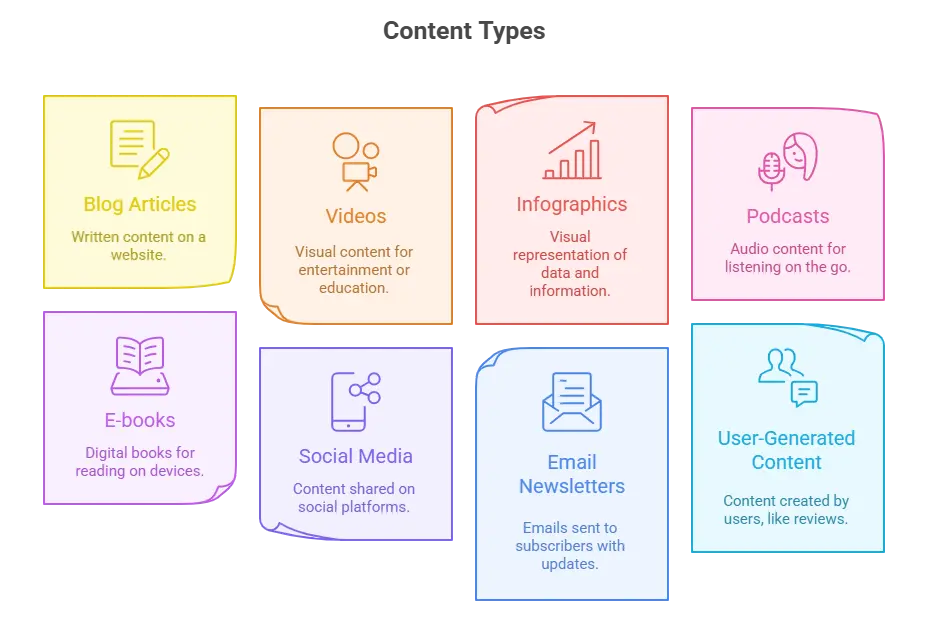
The nice thing: content marketing doesn’t mean only blog posts. It’s a buffet of formats. Here are some useful options:
- Blog articles – text pieces exploring questions, challenges, tips (e.g., “How to choose a digital marketing agency”).
- Videos – demonstrations, interviews, behind-the-scenes, short explainers.
- Infographics / visuals – useful for summarising data, processes, or visually representing ideas.
- Podcasts / audio – storytelling, conversations, useful for on-the-go audiences.
- E-books / whitepapers / guides – deeper dives, often used for lead-generation (download in exchange for email).
- Social media posts – shorter, engaging content tailored to each platform.
- Email newsletters – staying in touch, delivering value, building loyalty.
- User-Generated Content (UGC) / testimonials – great for authenticity (others talking about you).
The key: pick formats your audience uses, mix them wisely, and align them with your resources.
How to Build a Content Marketing Strategy
Here’s a roadmap—a kind of recipe—for building a content marketing plan. Think of each step as a gear in the machine.
1. Define your audience
Who are you creating content for? What are their pain points, questions, desires? What do they search for?
A clearly defined audience helps you choose topics, tone, channels.
2. Set clear goals
What do you want from content? More traffic? More leads? Stronger brand reputation? More repeat customers?
Use metrics (KPIs) like number of leads, time on page, conversion rate, return visitors.
3. Audit existing content (if you have any)
What content already exists? What performed well (and why)? What gaps exist?
4. Choose themes, topics, formats and channels
Based on your audience and goals, decide:
- What topics your audience cares about
- Which formats resonate (blog, video, infographics…)
- Which channels you will publish on (website, YouTube, LinkedIn, Instagram…)
- How often you will publish
5. Develop a content calendar
Consistency matters. Map out what content will be published, when, where, by whom.
Plan for mix: evergreen content + timely/trend content.
6. Create and optimise content
- Ensure quality: write well, design well, speak clearly.
- Optimise for SEO (especially for blogs/videos) so your content can be discovered.
- Make it shareable: engaging headline, good visuals, clear take-away.
- Make sure it speaks to the audience, not to you.
7. Publish and promote
Good content on its own is not enough. You must promote it: share on social, email it, partner with influencers, repurpose it into smaller bites.
8. Measure and iterate
Check your metrics. For content marketing: page views, time on site, bounce rate, social shares, lead conversion rate. If something isn’t working—adjust topic, channel, format.
9. Repurpose and recycle
Turn a blog post into an infographic. Infographic into slides. Slides into social posts. Maximise the value of each piece of content.
10. Stay current and evolve
Content marketing is not static. Audience behaviour changes, platforms evolve, formats shift (think: short-form video, live streaming, audio). Keep adapting.
Common Challenges & How to Overcome Them
This section is your “watch-out” zone—because while content marketing is powerful, it’s not without its hurdles.
Challenge: Creating consistent quality content
Solution: Build a content production workflow, assign roles (writer, editor, designer). Use an editorial calendar. Consider outsourcing or using freelancers if needed.
Challenge: Measuring ROI
Solution: Choose measurable goals early, track relevant metrics, link content to the customer journey (i.e., how content supports lead → sale). Start simple and refine.
Challenge: Audience fatigue / standing out in the noise
Solution: Focus on specific niche or unique angle instead of being “generic”. Use storytelling, put your personality in. Monitor trends and ride them when relevant.
Challenge: Resource constraints (time, budget)
Solution: Prioritise content types with best return. Repurpose more. Use user-generated content or collaborations. Use automation tools where possible.
Challenge: Staying relevant across platforms
Solution: Know where your audience is, and don’t try to be everywhere at once. Choose 1-2 channels to excel in, then expand. Also, keep learning about format trends (e.g., short videos, audio, interactive content).
Content Marketing Trends & What to Watch for in 2025
To stay ahead of the curve, these are some trends worth keeping an eye on:
- Personalisation & data-driven content: Audiences expect content that speaks to them—not generic one-size-fits-all. Using insights, behaviour data to tailor content improves relevance.
- Short-form video and micro-content: With platforms like TikTok, Instagram Reels, YouTube Shorts, audiences often prefer quick, engaging bites.
- Interactive content: Quizzes, polls, live Q&A, webinars—all create engagement rather than passive reading.
- User-Generated Content (UGC) & community-led content: Authentic voices matter more. People trust peer content.
- Content across the customer lifecycle: Not just top-of-funnel awareness, but deeper into consideration, decision, and loyalty.
- AI and automation in content production and optimisation: Tools that help you generate content ideas, optimise for SEO, even assist with first drafts.
- Sustainability, ethics and purpose-driven content: Audiences increasingly care about brand values. Content can reflect not just “what you sell” but “what you stand for”.
- Cross-channel synergy: Integrating content across website, social, email, events for coherent brand story.
How Content Marketing Works in Real Life
Let’s walk through a quick scenario to illustrate.
Suppose you run a software-services company that offers custom web and mobile app development. Your audience: small to medium-sized businesses in the US. Here’s how content marketing might play out:
- Awareness stage: You publish a blog post: “5 common mobile-app mistakes small businesses make (and how to avoid them)”. You optimise for search (SEO) so when your audience searches “mobile app mistakes”, your article shows up.
- Consideration stage: You create a downloadable guide: “Choosing the right development partner: A checklist for SMBs”. Visitors download it in exchange for their email.
- Decision stage: You publish case-studies: “How Company X increased engagement 120% with our app”. You also create a video testimonial.
- Loyalty stage: You send regular email newsletters with tips (“how to maintain your app post-launch”), invite clients to webinars, and publish blog posts about updates/trends.
Over time you’ve built trust, demonstrated expertise, captured leads, and supported your clients post-sale.
Tips for Doing It Well (and Avoiding the Ouch Moments)
Here are some practical, friendly tips:
- Write for your audience, not for yourself. Ask: What keeps them up at night? What questions do they ask?
- Keep your tone human — you’re not writing a corporate robot.
- Use strong headlines and compelling intros — people decide quickly whether to stay or bounce.
- Include visuals (images, infographics) to break up text and make content more shareable.
- Ensure your content is mobile-friendly. Many users will see it on smartphones.
- Promote your content actively — don’t publish and pray.
- Track what works and do more of that; kill what doesn’t.
- Repurpose: one blog → infographic → social posts → podcast mention.
- Stay patient: content marketing is a marathon not a sprint. Results build over time.
- Keep your brand voice consistent — and make sure your content aligns with your business strategy, not just “nice to have”.
- Be transparent: if you have a stake in something you talk about, disclose it. Authenticity matters in building trust.
Content Marketing Mistaken Identities (What It’s Not)
Just so you don’t accidentally confuse your tools:
- It’s not the same as traditional advertising. Content marketing invites you in; advertising often pushes you out.
- It’s not a once-off “write a blog and done” approach. It requires consistency.
- It’s not purely about the sale. It’s about serving first, selling second.
- It’s not ignoring measurement. Good content marketing tracks results and adapts.
- It’s not only long-form articles. Remember the buffet of formats.
Conclusion
If your business is like a ship sailing through a sea of competitors, content marketing is the lighthouse that helps you be seen, trusted, and chosen. By creating content that matters — for the right audience, through the right channels, with clarity and consistency — you build a brand that people don’t just notice, but remember and prefer.
Start with your audience. Serve them. Educate them. Engage them. Then over time, steer them toward your solutions. The journey won’t happen overnight—but done well, content marketing becomes one of your strongest strategic assets.
FAQs
Q1. How much content is “enough”?
There’s no magic number. Better to focus on quality and relevance than just quantity. However, consistency is key: pick a cadence you can maintain (e.g., one blog post per week) and stick to it.
Q2. Do I need to use every format (blog, video, podcast, etc.)?
Not necessarily. It’s smarter to master one or two formats your audience likes, rather than spreading yourself thin. You can expand later.
Q3. How do I measure whether my content marketing is working?
Key metrics: website traffic, time on page, bounce rate, social shares, leads generated, conversion rate. Link content to business goals (e.g., how many leads did a particular guide produce?).
Q4. How long will it take to see results?
Often several months. Content builds cumulative value—older posts can continue to attract traffic. Be patient and consistent.
Q5. What if I don’t have a big budget?
You don’t need a large budget to start. Begin with what you can: write blog posts, share on social, repurpose content. Focus on usefulness and relevance rather than high production cost.