
Many companies wait to look into SEO until something starts going wrong. Maybe it is an issue with declining site traffic, a fall in rankings without any obvious cause, or just the fact that nothing much is happening despite constant efforts made.
Then the discussion of White Hat SEO begins, especially when businesses start looking at the difference between White Hat and Black Hat SEO and how each approach actually performs over time.
It is not seen as just a trend in web marketing, nor is it considered a buzzword anymore. On the contrary, it appears as a more reliable SEO technique, because although there are quicker alternatives out there, their sustainability cannot be guaranteed in many cases.
In contrast, White Hat SEO offers a sustainable solution to boosting search engine rankings.
What White Hat SEO Actually Involves
In essence, White Hat SEO simply entails adhering to the guidelines of the search engines and ensuring that the site provides value to its users. However, in reality, it has less to do with guidelines and more to do with site development.
It usually comes down to a few core areas:
- Creating content that answers real search queries
- Making sure the website is easy to navigate
- Improving loading speed and mobile usability
- Building links in a way that feels natural and relevant
None of these stand out as quick fixes. They are small, consistent improvements that shape how a website performs in the long run.
That’s why White Hat SEO often doesn’t feel immediate while you’re working on it. The results build gradually rather than appearing all at once.
Why It Often Feels Slow in the Beginning
The length of time for an SEO campaign to show results is one of the major drawbacks of White Hat SEO, which frustrates many businesses after posting and optimizing content.
Most businesses experience an evaluation or lag period after they publish content when there is little or no change to rankings, traffic or general business success.
For businesses looking for quick success, this can be a frustrating time.
During the lag period, search engines evaluate your website’s entire content; track visitor behavior on the website; and gradually build confidence in the quality of your website. This evaluation process is essential in establishing a solid foundation for continued traffic to a business’s website in the future.
This is also the stage where the difference between White Hat and Black Hat SEO becomes more noticeable, even if it’s not obvious right away.
Once businesses have established a strong foundation with search engines, they tend to have a more consistent flow of results.
Difference Between White Hat and Black Hat SEO
If we take the long view of how results change over a period of time, then understanding how White Hat SEO differs from Black Hat SEO is important, especially when results are measured over a longer period.
White Hat SEO is a means of improving the overall quality of a site by earning trust in the industry through building authority over time. White Hat typically focuses on relevance and usability in order to get higher rankings than other tactics.
Black Hat SEO takes a different approach. It tries to manipulate rankings using tactics that may work temporarily but don’t align with search engine guidelines.
Some common differences include:
- White Hat SEO focuses on long-term growth, while Black Hat SEO aims for quick gains
- White Hat strategies build trust, while Black Hat methods introduce risk
- White Hat results tend to remain stable, while Black Hat results can drop suddenly
At first, both approaches might seem effective. But over time, the gap becomes more noticeable, especially when search engine updates come into play.
What Actually Makes White Hat SEO Work
There isn’t a single factor that drives success in White Hat SEO. It works because multiple elements come together in a consistent way.
Content plays a major role, but not just in terms of quantity. The pages that perform well usually feel complete without trying too hard. They answer questions clearly and stay focused on what the user needs.
Technical performance also matters more than it seems. A website that loads quickly and works smoothly across devices keeps users engaged, which directly affects how search engines evaluate it.
Backlinks add another layer. A few strong, relevant links can make a bigger impact than a large number of weak ones. It’s less about volume and more about credibility.
When these elements are aligned, the overall effect becomes stronger.
Common Challenges Businesses Face
Even when businesses understand the concept of White Hat SEO, execution is not always consistent.
For example, some companies prioritize content while ignoring technical aspects, others prioritize optimization while ignoring the user’s perspective, and there are also those who combine good techniques with quick-fix solutions.
A few common challenges include:
- Publishing content without a clear direction
- Ignoring site performance and usability
- Expecting immediate results from long-term strategies
- Relying on quantity instead of quality
These issues don’t always show immediate impact, but over time they can slow down progress.
Why White Hat SEO Builds Stronger Over Time
There is a longer term benefit of white-hat SEO than just immediate traffic growth.
Initially, growth is typically slower due to the time required for creating additional content and improving the website; however, when implemented correctly, results will compound or build upon one another as additional content is released and a website’s overall quality improves.
Older pages created several months ago will eventually continue driving reliable traffic, website rankings will stabilize over time, and there will be less need for ongoing updates or changes.
This is the power of compounded effort; when you utilize previously completed SEO-based marketing activities, those prior accomplishments create corresponding results as part of your future growth.
When White Hat SEO Makes the Most Sense
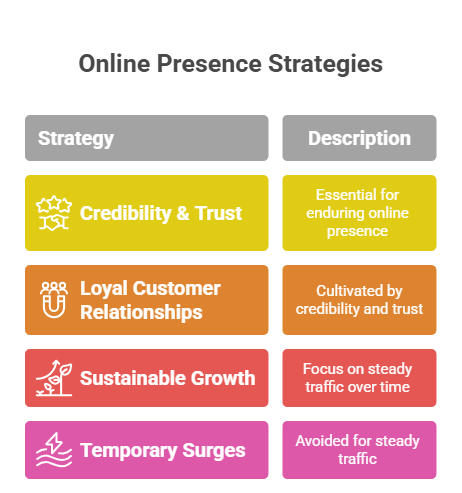
White Hat SEO is not always the fastest way to get results, but it becomes the better option in certain situations.
It works particularly well for:
- Businesses looking to build long-term online visibility
- Brands that rely on credibility and trust
- Websites that want consistent traffic rather than short spikes
In these cases, stability matters more than speed, which is where White Hat SEO stands out.
A Shift in How SEO Is Viewed
At a certain point, SEO takes on a new look.
Search engines are becoming less concerned with just ranking results and now are placing the focus on quality. It has become less about ranking using traditional methods and more about whether or not the content will earn its way onto the top page of today.
With this change in perspective, better conversations are being held about content, how to structure your site properly, and how to optimize both your site and content.
The SEO process is becoming less reactive and moving towards a more intent-driven approach.
Takeaway
There will always be quicker methods to improve your online exposure, yet many won’t stand the test of time.
White Hat SEO is a process that will take a while to develop. At first, this may seem like a disadvantage. However, White Hat SEO creates a solid framework that will last despite the adjustment of search engine algorithms.
For business owners who are planning for the long-term, stability is more useful than instantaneous results.
As time passes, the results of using White Hat SEO will become apparent.
FAQs
1. How long does White Hat SEO actually take to work?
That’s probably the first thing most people ask. White Hat SEO does not deliver immediate results. It would take some time before the changes become visible, especially when you are working on a new website or an existing one that operates within a very competitive niche.
2. Why does White Hat SEO feel slow in the beginning?
Initially, it may seem that nothing much is happening. This is because white-hat SEO is not an instant process. Search engines need time to comprehend your information and user interaction and to determine the credibility of your website. It is the time where most people get impatient.
3. What is the difference between White Hat and Black Hat SEO in simple terms?
The difference between White Hat and Black Hat SEO really comes down to approach. White Hat SEO improves the site for real users whereas, the Black Hat SEO takes a shortcut to rank the site that is short-lived. One builds steadily, the other can drop just as fast as it rises.
4. Is White Hat SEO still effective today?
Yes, in fact, it is even more relevant than ever before. With more advanced filtering mechanisms implemented by search engines against poor quality websites, White Hat SEO strategies are bound to yield better results in comparison to other methods.
5. Can you switch from Black Hat to White Hat SEO later?
You can, but it doesn’t happen instantly. If a website has previously taken any shortcuts, then reversing those changes to create a proper White Hat SEO solution will require some time. It is more a case of slowly fixing problems than switching something on.
6. Does White Hat SEO guarantee stable rankings?
There is nothing certain in SEO. Even when you apply White Hat SEO the ranking could rise and fall. However, the falls will be less severe and easy to recover from, since the base is much stronger.
7. Why do some businesses still use Black Hat SEO if it’s risky?
Mainly because it can yield fast results. In case a person is solely interested in obtaining immediate results, the distinction between the White Hat and Black Hat SEO may initially go unnoticed. The problem usually shows up later, when rankings suddenly disappear.
8. Is White Hat SEO only about content?
No, not entirely. While content plays an important role in White Hat SEO, there is more to it than just content. There is also site performance, usability, and the ability to earn links naturally. Concentrating solely on content without considering other factors might lead to inefficiency.
9. Who should focus on White Hat SEO the most?
Any business looking for sustainable growth. This is because White Hat SEO suits firms seeking constant traffic without having to solve the problem of frequent dips in their traffic.
10. Does understanding the difference between White Hat and Black Hat SEO really matter?
It does, especially over time. In the initial stages, both the strategies may appear to be alike in their output. However, the distinction between the two SEO techniques is made evident through subsequent updates as rankings become stable or plummet.
Also read: digital-marketing-agencies-how-they-help, digital-marketing-projections-for-2026, what-is-content-marketing, seo-vs-paid-ads-in-2025-best-marketing-investment, seo-mistakes-to-avoid-search-intent, llm-seo-guide, On Page SEO Checklist, Social Media Algorithms, The Top Digital Marketing Agency in USA, User Generated Content in Digital Marketing, How AI is Changing Digital Marketing, SEO Services in Agra, Best SEO Company in Agra, AEO vs SEO, SEO vs SEM