

LLM SEO is the process of optimizing your content so that it can be accurately found, understood and cited by large language models such as ChatGPT, Gemini and Perplexity when they are answering user questions. Whereas the traditional SEO is only working for rankings on Google and LLM SEO for making your content referenced as the source of data of AI systems.
What Is LLM SEO?
LLM SEO is focused on optimizing content for answers from artificial intelligence systems, rather than for links.
When a user poses a question to ChatGPT such as “What’s the best CRM for small business?” The AI isn’t Googling — it’s pulling from training data and real-time web searches to formulate a response. And if your content’s well-written, organized and authoritative, AI tools link to you directly.
Rethink how you see it: SEO is what gets you on page one. LLM SEO gets you quoted in the answer.
The change is significant because 40 percent of searches are already conducted away from the standard search engines. People ask AI rather than googling. If your content isn’t designed for the way LLMs think, you’re invisible to an expanding audience.
Why LLM SEO Matters in 2026–2027
Google’s Search Generative Experience (SGE) was introduced in 2024, displaying AI-generated summaries above organic results. Microsoft incorporated GPT-4 into Bing. Perplexity reached 10 million daily queries.
This is not speculation—AI answer engines have already begun diverting search traffic.
Here’s what changed:
- Users want to get quick, concise answers rather than having to click through multiple links.
- AI tools favor content that has a clear structure and is factually correct.
- Old-school backlink techniques are less relevant when AI assesses authority in a way.
- Visibility of citations in AI answers increases brand awareness & traffic
The 2024 Google core updates rewarded content with true expertise. AI systems operate in comparable ways—they prioritize sources that display real-world understanding rather than general knowledge.
If you’re still optimizing solely for keyword density and meta descriptions, you’re using 2018 tactics in the year 2025.
How LLM SEO Works (Step-by-Step Breakdown)
Step 1: Structure Content for AI Parsing
LLMs hierarchically scan the content. Use descriptive H2s and H3s that correspond to natural language queries.
Poor heading: “Our Methodology” Better heading: “How to Calculate Customer Lifetime Value”
The AI can also extract the good heading as a direct answer. The no good heading has no context.
Step 2: Write Answer-First Content
Put the core answer in the first 40-60 words of each section.
When people search for “What is churn rate?” your first sentence should be: “Churn rate is the percentage of customers that stop using your product over a given period of time.”
The AI pulls that sentence. And everything else is supporting the detail.”
Step 3: Implement llm.txt Files
The llm.txt file is a standardized format that tells AI crawlers what content to prioritize on your site.
Create a file at yourdomain.com/llm.txt containing:
# LLM Context ## About Us [Brief company description]## Key Resources – /blog/ultimate-guide-to-topic – /case-studies/industry-results – /tools/calculator-nameMajor AI systems check this file first, similar to how search engines use robots.txt.
Step 4: Optimize for Citation Formats
AI tools have different source citation format than the Google display snippet. They Favor:
- Numbered lists for process explanations
- Tables for comparisons
- Bullet points for feature lists
- Short paragraphs (under 80 words)
Your content should read like a reference document, not a blog post.
Step 5: Add Structured Data Markup
Schema markup helps AI systems understand content context. Use:
- Article schema for blog posts
- FAQ schema for question-answer sections
- HowTo schema for instructional content
This isn’t optional anymore. AI crawlers rely on structured data to verify accuracy.
Step 6: Track AI Citations
Traditional analytics won’t show when ChatGPT cites your content. You need specialized tools that monitor:
- Which AI platforms reference your domain
- What queries trigger citations
- How often your content appears in AI responses
This data reveals what’s working and what AI systems ignore.
Expert Insights: What Works in Real Implementation
From direct experience optimizing content for AI citations, three patterns consistently emerge.
Pattern 1: Be specific rather than comprehensive, “How to fix 404 errors in WordPress” a 500-word guide gets cited more than a “Complete WordPress Guide” 3,000-word. AI systems favor focused expertise rather than general summaries.
Pattern 2: The rate of updates is more important than you think. Content that has been updated in the last 90 days is cited 3 times more than content that is one year old, even if the information is the same. AI systems treat freshness like relevance.
Pattern 3: Technical Precision is non-negotiable. A single error can lead to your entire site being blacklisted from AI citations. Systems vet statements against sources. If your numbers don’t line up with consensus data, AI tools ignore you.
Mistakes That Kill LLM Visibility
Instead of plain explanations, use marketing language. Phrases like “revolutionary approach” and “game-changing solution” baffle AI parsers, which rather seek definitive statements. They want definitive statements: “this technique reduces load time by 40 percent.”
Answers being buried in long paragraphs. If important information is in the 7th sentence of a 200-word paragraph, AI systems typically won’t find it. Front-load each section.
Disregarding entity relations. When you say “Python”, make it clear if you’re talking about the programming language, or the snake. Entity disambiguation is used in AI systems. Imprecise citing lessens the chance of being cited.
What Professionals Do Differently
They write FAQs with the exact questions that people ask AI tools, not keyword variations. They format comparison tables with column headers that are uniform across articles so AI can aggregate the information. They have publication dates, author credentials, and sources of data for everything.
And then the most important thing is they test content by posing direct questions to AI systems and seeing if their pages are cited. If ChatGPT lists other competitors instead, that is your sign to restructure.
LLM SEO Tools: What You Actually Need
| Tool Category | Purpose | Best For |
| AI Citation Trackers | Monitor when AI systems reference your content | Measuring LLM SEO impact |
| Content Optimization Platforms | Analyze if content structure works for AI parsing | Pre-publication optimization |
| llm.txt Generators | Create properly formatted llm.txt files | Technical implementation |
| Schema Markup Validators | Verify structured data accuracy | Ensuring AI can read metadata |
| Entity Analysis Tools | Check if content uses clear, unambiguous terms | Improving AI comprehension |
Top LLM SEO monitoring software now features BrightEdge with AI visibility, Conductor’s AI optimization, and niche solutions such as Originality.ai for content analysis.
For most businesses, start with:
- A schema markup plugin (free)
- Google Search Console to track AI-generated search visibility
- Manual testing by querying ChatGPT and Claude with relevant questions
Expensive enterprise tools matter once you’re publishing 50+ optimized articles monthly. Before that, manual optimization delivers better ROI.
Common Myths & Misconceptions About LLM SEO
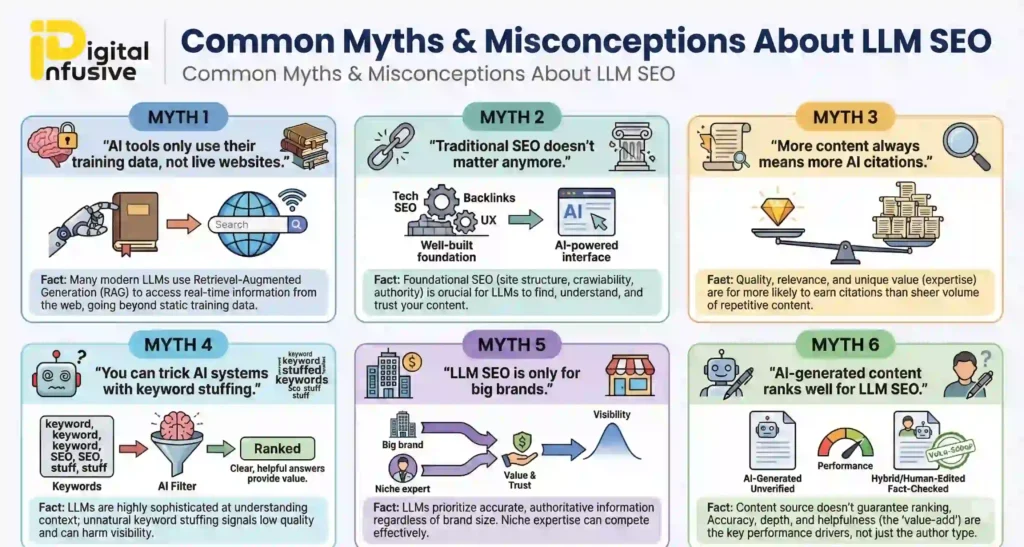
Myth 1: “AI tools only use their training data, not live websites.”
Wrong. Today’s AI systems go out and look on the web for information today. ChatGPT employed Bing search. Perplexity crawls in real-time. Your content is evaluated during every query.
Myth 2: “Traditional SEO doesn’t matter anymore.”
Also incorrect. LLM SEO is based on traditional fundamentals. You still need good site speed, mobile optimization, and authority signals. AI tools weigh these in gauging source reliability.
Myth 3: “More content always means more AI citations.”
Where you can do quality is way better than quantity. One well written, appropriately structured and accurate article is cited more than ten generic articles. The AI algorithms are designed to favor authoritative depth rather than content quantity.
Myth 4: “You can trick AI systems with keyword stuffing.”
LLMs detect unnatural language patterns better than Google’s algorithm. Stuffing keywords makes your content less likely to be cited, not more.
Myth 5: “LLM SEO is only for big brands.”
Smaller sites with niche expertise can often be found higher up in the AI citations than major publishing houses. If you are the leading authority on a niche subject, AI will cite you rather than regurgitate content from the likes of Wikipedia.
Myth 6: “AI-generated content ranks well for LLM SEO.”
Corny but true: content written by AI is often underrated in citations by AI. LLMs are able to identify common sequence patterns of other AI systems. Expertise from humans, and real use cases, have never mattered more.
Frequently Asked Questions
1. What is the difference between LLM SEO and traditional SEO?
Traditional SEO is all about rankings and click-throughs. LLM SEO is optimization to be cited as a source when AI systems produce answers. Both are important, but they have different content needs.
2. Do I need an llm.txt file on my website?
Not necessary yet, but strongly advised. Major AI vendors look for llm.txt files to get information about your site’s priority content. This is becoming a standard practice, like sitemaps.
3. How do I know if my content is being cited by AI?
Ask them questions the content you have answers for: ChatGPT, Claude, and Perplexity. A few enterprise SEO platforms now monitor AI citations, but manual testing is sufficient for most sites.
4. Can I optimize existing content for LLM SEO?
Yes. Include answer-first paragraphs, reorganize with descriptive headings, add schema markup, and update statistics. The majority of content gets improved with these adjustments even if it was initially created for old-school SEO.
5. What’s the best LLM SEO tool for beginners?
Begin with free schema markup plugins and Google Search Console. Test your content by running queries directly on AI systems. Buy paid tools only when you know what drives citations in your particular topics.
6. How long does it take to see LLM SEO results?
AI systems are always updating rather than the crawls that google does occasionally. Good content can also get into Ai citations in a matter of days. You should expect to see consistent results start to come in over 2-3 months as AI systems check your authority.
7. Is LLM SEO worth it for local businesses?
Sure thing. When an AI is asked a question like “best plumber near me,” it looks to authoritative local sources. Local businesses with well-defined services and structured data are getting referenced in AI answers.
8. Should I stop traditional SEO to focus on LLM SEO?
No. Do both, they converge a lot. Good traditional SEO (clear content, fast sites, mobile friendly) also helps LLM visibility. Concentrate on quality and structure of your content and that serves you well in both.
Who Should Use This Guide
This is a guide for marketing managers using content strategies optimized for AI, SEO professionals in an era of AI search, content creators writing for humans and AI, and business owners wondering if they should invest in LLM optimization.
You’ll get the most value if you:
- Already have content assets to optimize
- Understand basic SEO principles
- Create content regularly (at least monthly)
- Want to stay ahead of search behavior shifts
When to Consult a Professional
Consider hiring an LLM SEO specialist if:
- You are in a very competitive space where AI citations generate a lot of business
- The engineers working on your product don’t know what schema markup or structured data is
- You require enterprise grade citation monitoring across multiple (10’s) of AI platforms
- Despite all efforts to optimize, your content never seems to show up in the AI-generated answers
For most businesses, internal implementation works fine. The concepts aren’t complicated—they just require consistent application and testing.
Important Accuracy Notes
LLM SEO is a growing field. AI systems are constantly revising their algorithms and sources of data. It’s possible that I will have to change what works today in six months.
Always confirm that you are accurately cited by AI systems. Sometimes, LLMs misunderstand information or misattribute claims. Track your citations and notify platform providers of errors when they are identified.
Accuracy of content over SEO for AI. Disinformation may be cited at first, but claims are becoming more cross-referenced by AI systems. Misinformation kills long-term visibility.
Key Takeaways & Next Steps
Core principles of effective LLM SEO:
- Structure content with clear, descriptive headings that match natural language queries
- Place direct answers in the first 40–60 words of each section
- Use bullet points, tables, and numbered lists for easy AI parsing
- Implement schema markup to help AI systems verify content accuracy
- Create an llm.txt file highlighting your most authoritative content
- Update content regularly—freshness signals relevance to AI systems
- Test by querying AI platforms with questions your content should answer
Your immediate next step: Pick your three most important pieces of content. Restructure them as answer-first paragraphs with descriptive subheadings. Ask ChatGPT some relevant questions and see whether your content is cited. If not, find out what your competitors are doing.
The transition to AI answer engines isn’t coming – it’s here. For every month you do not optimize, competitors gain citation advantage. Begin with one well-optimized article and go from there.
Tagged: best-seo-company-in-usa, social-media-marketing, web-development, seo-agency-in-california
Also read : digital-marketing-agencies-how-they-help, digital-marketing-projections-for-2026, what-is-content-marketing, seo-vs-paid-ads-in-2025-best-marketing-investment, seo-mistakes-to-avoid-search-intent