
Long gone are the days when a small ad in the newspaper, one short clip on the radio, or a seasonal promotion on a roadside banner led to booming businesses. The introduction of the internet didn’t simply bring global connectivity but also allowed businesses to find their clients worldwide.
This is exactly why today’s economy is referred to as a digital-first economy. People now believe your business’s credibility based on your reputation online. From startups and e-commerce brands to B2B enterprises and multinational corporations, all switched to Digital Marketing. And for decades now, digital marketing has been successfully connecting businesses to their target audiences globally. However, with the daily advancement of technology, artificial intelligence, better marketing assistance, and measuring metrics , people want faster, better results, cost-effectively.
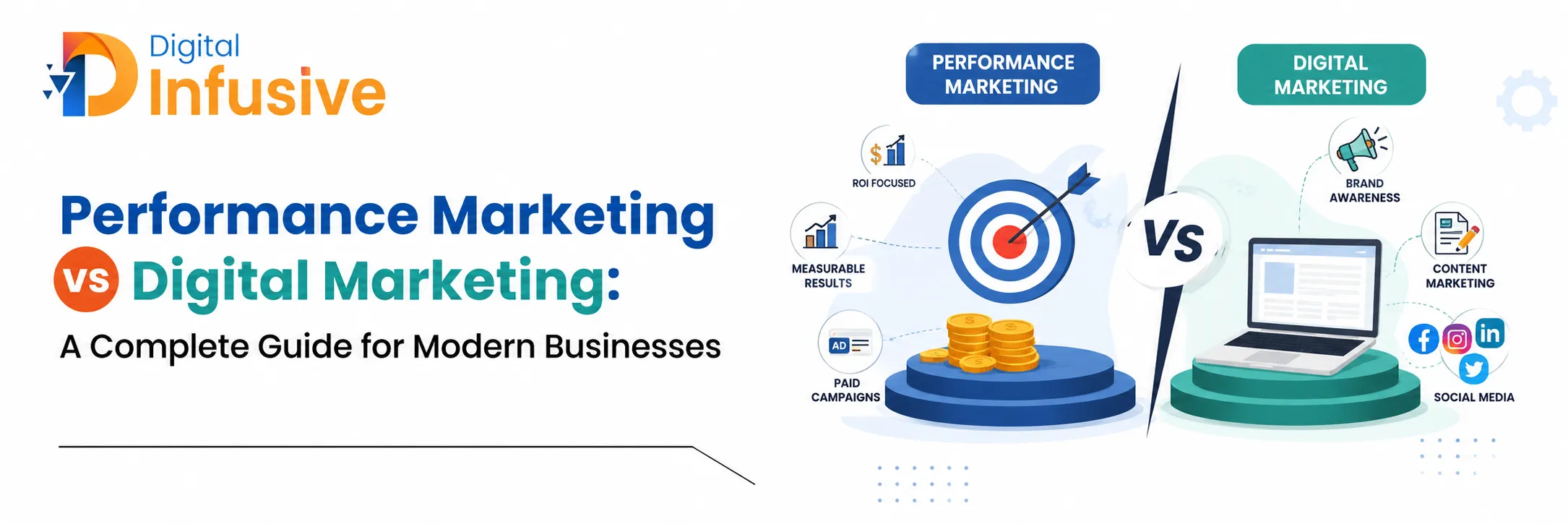
This leads to the huge question all huge businesses are asking today: Performance Marketing vs Traditional Digital Marketing, and which is better for their business?
The answer isn’t as simple as choosing one over the other. While one may suit a business’s immediate goal, a different business might benefit from a different approach.
To determine which marketing is best-suited for your business goals, let’s start by understanding both marketing approaches and the difference between them.
Digital Marketing vs Performance Marketing
What is Digital Marketing?
In simple terms, Digital marketing refers to all marketing strategies and efforts done digitally using the internet or electronic devices. It uses various strategies, such as Search Engine Optimisation (SEO), Content Marketing, Social media Marketing, Pay-per-click Advertising (PPC), Email Marketing, and Influencer and Affiliate Marketing.
The primary objective of digital marketing is to build awareness of the business and its authority, driving long-term business growth. Unlike traditional marketing, digital marketing allows businesses to engage specifically with their targeted audience or potential customers.
What is Performance Marketing?
Performance Marketing, on the other hand, is a ROI driven approach to marketing, where businesses pay only when a specific, measurable action, such as a click, lead, or sale, is completed. Other measurable actions include app installs, form submissions, downloads, registrations, etc., as per a business’s unique needs.
This approach relies heavily on data and analytics. Some of the important KPIs of performance marketing include Cost Per Click (CPC), Cost Per Acquisition (CPA), Cost Per Lead (CPL), Return on Ad Spend (ROAS), Conversion Rate, Customer Acquisition Cost (CAC), and Lifetime Value (LTV)
Unlike traditional digital marketing models, businesses don’t have to pay upfront and pay only after receiving desired outcomes, making it a more cost-efficient model of digital marketing.
Why Businesses Love Performance Marketing?
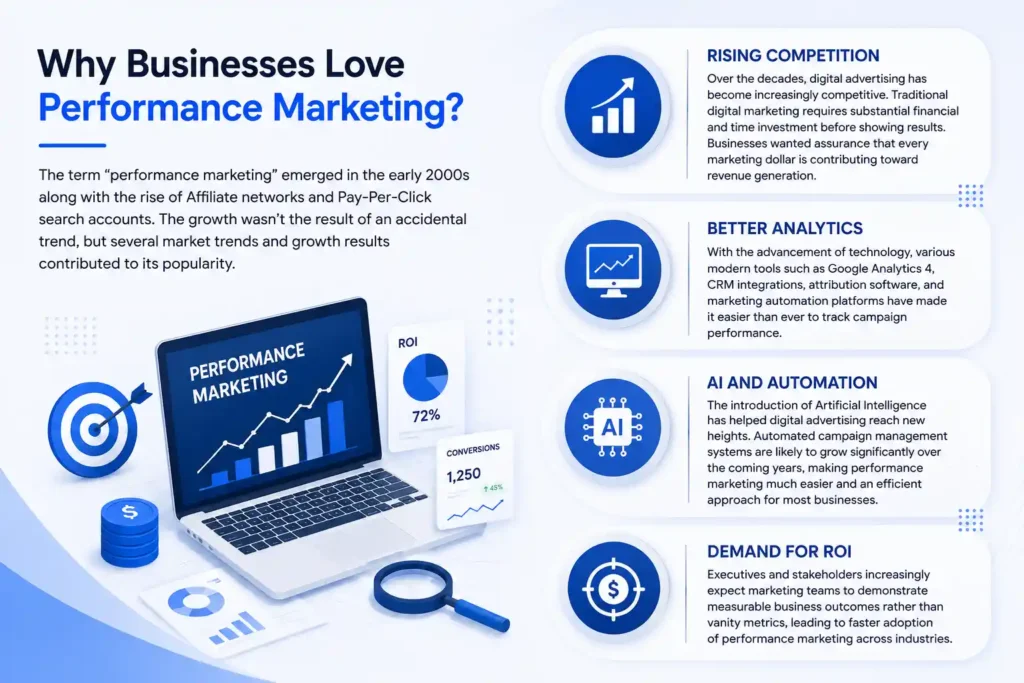
The term “performance marketing” emerged in the early 2000s along with the rise of Affiliate networks and Pay-Per-Click search accounts. The growth wasn’t the result of an accidental trend, but several market trends and growth results contributed to its popularity.
Rising Competition
Over the decades, digital advertising has become increasingly competitive. Traditional digital marketing requires substantial financial and time investment before showing results.
Businesses wanted assurance that every marketing dollar is contributing toward revenue generation.
Better Analytics
With the advancement of technology, various modern tools such as Google Analytics 4, CRM integrations, attribution software, and marketing automation platforms have made it easier than ever to track campaign performance.
AI and Automation
The introduction of Artificial Intelligence has helped digital advertising reach new heights.
Automated campaign management systems are likely to grow significantly over the coming years, making performance marketing much easier and an efficient approach for most businesses.
Demand for ROI
Executives and stakeholders increasingly expect marketing teams to demonstrate measurable business outcomes rather than vanity metrics, leading to faster adoption of performance marketing across industries.
Core Difference between Performance Marketing and Digital Marketing
While Digital marketing creates the foundation of a business’s online visibility, Performance marketing focuses on quick, measurable outcomes.
The introduction of performance marketing has brought a huge shift in the digital marketing industry. Global digital ad spend is expected to surpass $950 billion in 2026, with Google’s own economic search suggesting an average $2 profit for every $1 spent on Google Ads.
This clearly shows how businesses are increasingly investing in performance marketing due to its measurable ROI. However, focusing solely on performance marketing can be risky. Neglecting SEO, content marketing, social media engagement, and building an overall authority in the digital market can lead brands to find themselves trapped in an endless cycle of advertisement spend with little to no recurring business.
Think of it as:
Digital marketing builds your business’s long-term presence and authority.
Performance marketing focuses on generating faster, measurable outcomes.
Performance Marketing vs. Digital Marketing: Performance Table
| Factor | Digital Marketing | Performance Marketing |
| Primary Goal | Awareness, engagement, growth | Leads, conversions, sales |
| Scope | Broad | Specialised |
| Payment Model | Fixed Budget | Pay for performance |
| Time Horizon | Long-term and short-term | Primarily short-term |
| Success Metrics | Traffic, engagement, awareness | Revenue, leads, ROAS |
| Brand Building | Strong focus | Limited focus |
| Measurability | Moderate to high | Extremely high |
| ROI Tracking | Sometimes indirect | Direct and measurable |
This is the reason why most successful businesses today aim to strike a balance between both marketing approaches to receive both immediate results and long-term business value.
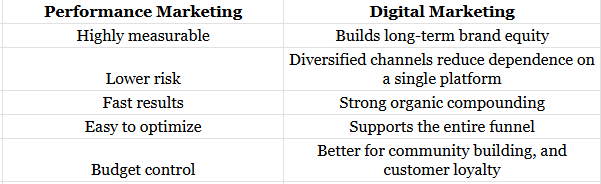
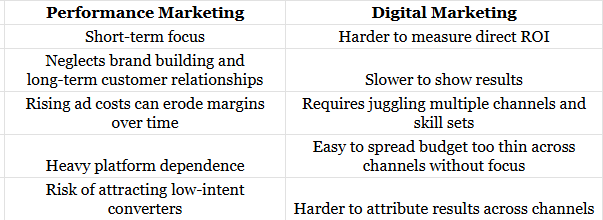
Advantages and Disadvantages of Digital and Performance Marketing Channels
Understanding both advantages and disadvantages of both Digital and performance Marketing can help businesses determine the best marketing approach for their business goals and make informative decision.
Advantages:
Disadvantages:
Role of SEO in Performance Marketing
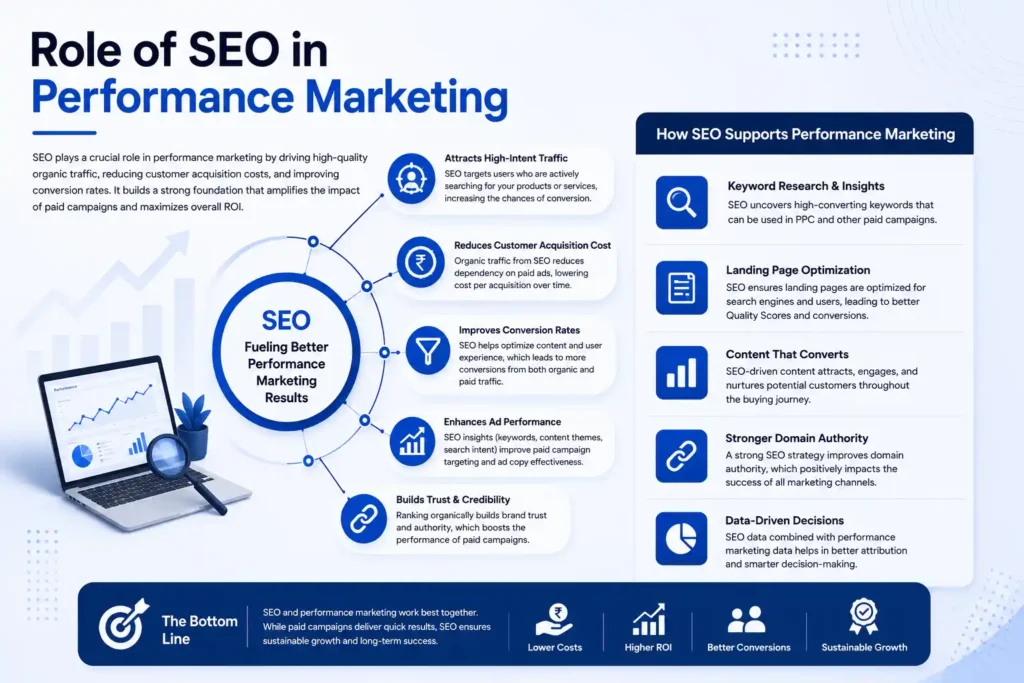
Contrary to popular belief, SEO can be just as important in performance marketing as it is in digital marketing. Modern SEO often overlaps with it.
Where traditional SEO focuses on ranking, organic traffic, visibility, and brand awareness, SEO in performance marketing focuses on outcomes that directly impact business growth, such as lead generation, sales, revenue, qualified traffic, and customer acquisition.
According to industry research, content marketing can generate significantly more leads at a lower cost than traditional marketing, making SEO a highly effective long-term growth channel. While it takes time to deliver results, performance marketing SEO establishes better rankings, drives consistent traffic, and brings consistent leads for both short-term and long-term growth.
How is B2B Performance Marketing Different Than B2C Performance Marketing?
Performance marketing for B2B companies can vary significantly from B2C marketing.
The buying journey is typically longer, more complex, and involves multiple decision-makers; hence, it requires a more strategic approach.
Effective B2B Performance marketing tactics include LinkedIn Advertising, Account-Based Marketing (ABM), Lead Nurturing, Content Marketing, and B2B Performance Marketing Metrics. These tactics cater more to B2B needs, focusing more on generating high-quality leads for complex, high-ticket services driven by logic and ROI.
Why Businesses Struggle with Marketing Performance?
Despite increased marketing investments and the introduction of AI -integrated automation tools, many businesses still face challenges such as rising advertising costs, poor attribution, low conversion rates, weak landing pages, and inconsistent lead quality. Due to these reasons, marketing still remains expensive and unpredictable for most businesses.
This is where professional expertise becomes critical. Business requires more than just strategy, optimisation, analytics, and execution to stand a chance in the ever-growing digital competition.
This is where we come in…
How Digital Infusive Can Help Your Business With Performance Marketing and Digital Marketing?
Running simple advertisements, posting daily on social media, or publishing content on your website is no longer enough in today’s competitive marketplace. Business requires a strategic marketing partner that understands the nuances of ever-changing algorithms and how to use them to meet your business’s unique needs and goals.
Digital Infusive is one of the leading digital and performance marketing agencies in India, helping businesses bridge the gap between visibility and revenue. Our team includes professionals with market experience who understand how to attract the right audience, convert prospects into customers, and continuously optimize campaigns for maximum return on investment.
Our approach combines the long-term power of digital marketing with the measurable outcomes of performance marketing to create sustainable business growth.
Rather than focusing on vanity metrics such as impressions and clicks alone, we prioritize metrics that matter, such as Leads, Sales, Revenue, Return on Ad Spend (ROAS), Customer Acquisition Cost (CAC), and Customer Lifetime Value (CLV).
Whether you are a start-up enticing the digital competition, fresh looking to hit your first milestone, or an established business looking to expand, or a B2B brand looking to build long-term authority in the marketplace, we develop customized marketing strategies aligned with your business goals.
Final thoughts
The debate around performance marketing vs digital marketing often confuses businesses, leading them to make the wrong choice.
The truth is neither is better than the other, rather two different approaches to achieve separate goals. Most businesses require both to build long-term value and ensure their growth investments offer timely returns.
One builds the foundation, the other accelerates growth. Successful businesses understand that a balance of both is required to drive measurable growth.
In case you need a more in-depth understanding of the difference between digital and performance marketing or simply require SEO, performance marketing campaigns, lead generation, content marketing, social media management, or a complete digital growth strategy, contact Digital Infusive today.
Our team at Digital Infusive would be happy to assist you directly or help you make an informed decision that combines strategy, creativity, analytics, and optimization to help you attract the right audience, convert more customers, and maximize ROI.
Frequently Asked Questions
1. Is performance marketing better than digital marketing?
Not necessarily. Neither is better than the other. Performance marketing offers faster, measurable outcomes, while digital marketing allows businesses to build long-term value. Most businesses benefit from using both.
2. What is the difference between performance marketing and traditional digital marketing?
Traditional digital marketing often prioritizes awareness and engagement, whereas performance marketing focuses specifically on measurable actions such as leads, sales, and conversions.
3. What are performance marketing channels?
Google Ads, Meta Ads, LinkedIn Ads, affiliate marketing, influencer marketing, and programmatic advertising are a few popular performance marketing channels
4. Can SEO be considered performance marketing?
Yes. SEO plays a vital role in performance marketing strategy, focusing directly on outcomes that directly impact business growth, such as lead generation, sales, revenue, qualified traffic, and customer acquisition.
5. Which industries benefit most from performance marketing?
Most industries, including SaaS, eCommerce, healthcare, real estate, education, finance, and professional services, often achieve excellent results through performance marketing.
6. How can businesses work with Digital Infusive?
To work with Digital Infusive business can either book a free appointment with us through our website or reach out to us via email at info@digitalinfusive.com


